The Inside Word

The right is wrong about the right
Your base won’t save you
Conventional wisdom on the center-right goes like this: the Coalition lost the 2025 Federal Election because it wasn’t conservative enough, so the fix is to move further right and rally the base. The evidence from Australia and the United States says otherwise.
Australia: the voters who walked away
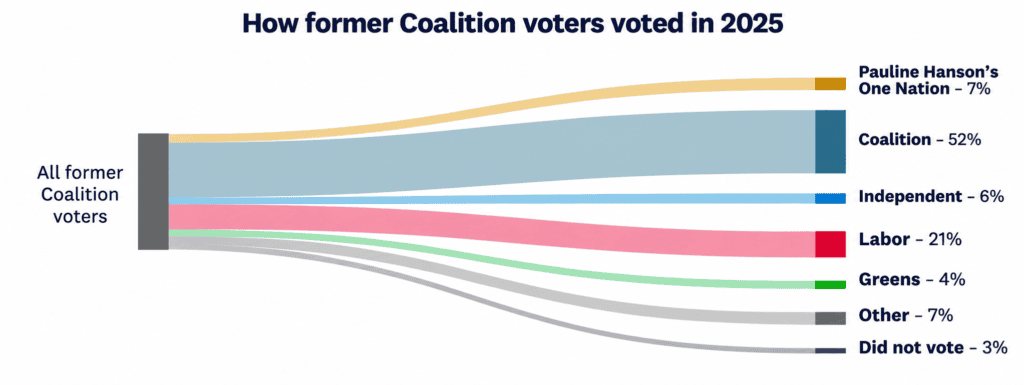
The most striking number in Blueprint Institute’s YouGov research (5,007 voters, July 2025) is 48%. That’s the share of former Coalition voters who didn’t vote Liberal or National at the last election, a pool of more than five million people. They skew towards working parents with young children, full-time workers and mortgage holders.
Of that number, 25%, one in four former Coalition voters, went to Labor or the Greens in 2025. That’s more than half of all defectors. Only 7% went to One Nation.
These aren’t voters who left because the Coalition was too moderate. 59% said it’s out of touch with modern Australia, and 48% said it doesn’t reflect their values. About half say it’s out of step with their priorities on climate and renewables, while several cohorts still trust it on the economy, infrastructure and national security. And 53% wanted it to keep net zero, against 29% who didn’t.
Yet the Liberal Party formally abandoned its net zero by 2050 target after this research was done. The poll suggests it did so against the preferences of the very voters it needs back.
America: the red wall cracks
The US midterms show the same dynamic on a much larger scale. Democrats flipped both chambers, and the Senate map is the striking part. Texas elected a Democratic senator for the first time since 1988, and in Kansas, Adam Hamilton became the first Democrat to win a Senate race there since 1932. South Carolina, which Trump won by nearly 20 points in 2024, hasn’t elected a Democratic senator since 1998, and Iowa hadn’t since 2008. Ohio, North Carolina and Maine flipped too.
Few of these states were supposed to be competitive. Their results look like a protest vote against Trump and his agenda. Trump’s approval sat at 38%, historically low for a midterm, and roughly six in ten voters said he was a factor in their House vote. Independents backed Democrats by 22 points, a 16-point swing from 2024. Most Maine voters felt Susan Collins was too close to Trump. Even Republicans concede the pattern: Ted Cruz said Republican-leaning voters turned out and voted Democrat, and Vice President Vance acknowledged that many 2024 Trump voters switched.
The common thread
In both countries, the voters who decide elections are neither ideological nor loyal to a brand. They’re anxious about the cost of living (89% of US voters called it a major or crucial factor) and wary of parties that look consumed by internal fights or culture wars. A harder line energises those already voting for you. It does little for the people who’ve left, and the 2026 US midterm results suggest it can push away voters who’d given you a chance.
The case for a different strategy
Advocates of this view argue the way back is credibility, not a sharper turn to the right. In the Blueprint survey, 80% of ex-Coalition voters said the party needs a more comprehensive and credible policy platform before they’d consider it, and 52% said they’d only back a party with credible climate policy. They aren’t asking conservatives to abandon their principles. They want evidence of competence on the problems they face. They want to see how those conservative principles might inform policy responses to the issues important to them. They want a genuine alternative.
Victoria’s November 28 State Election will be the first local test since the US midterms.
Whichever way it lands, you can be sure SAS Group’s team of tragics will be front and centre!