The Inside Word

Insights from the 2025 Australian Election Study
Ten structural signals shaping Australian politics after the 2025 federal election
The 2025 Australian Election Study (AES) provides the deepest view yet of the forces shaping Australian political behaviour. Beyond headline results about leader popularity, the study points to long-term trends in how voters think about government, economic stress, social issues, party identity and institutional trust.
Below are 10 of the most significant insights, each grounded directly in the 2025 AES Trends Report and the 2025 AES Election Results Report.
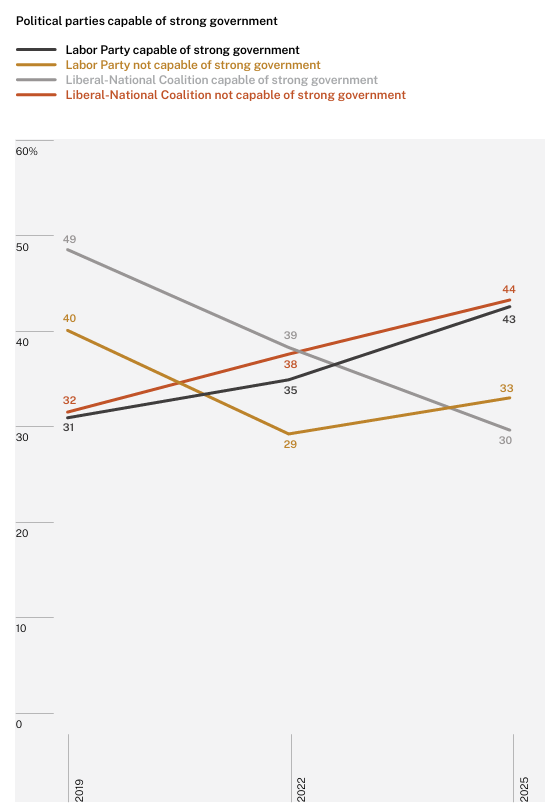
1. Labor now leads on ‘strong government’ – a historic reversal
Voters now see Labor as the party more capable of providing ‘strong government’, reversing more than 30 years of Coalition dominance on this measure. Labor is judged ‘capable’ and rises to 43%, while the Coalition falls to 30%.
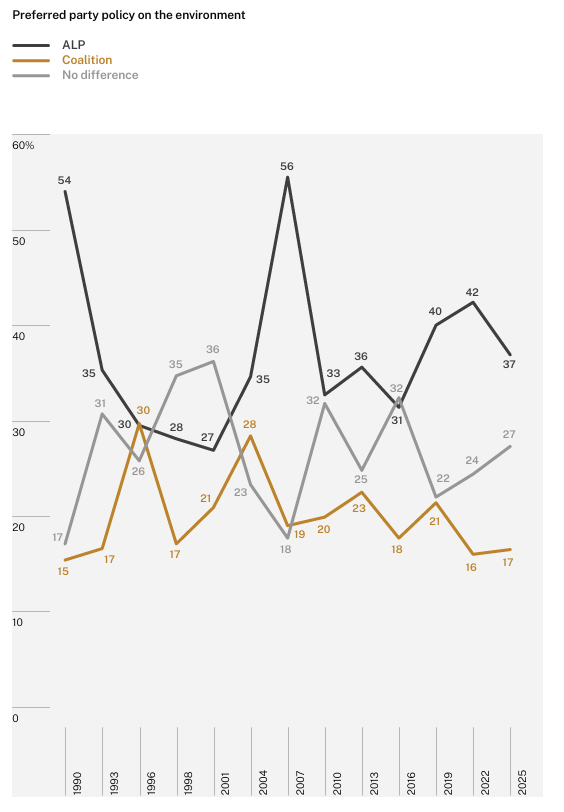
2. Climate concern has softened and party differences now matter less
While Labor remains preferred on the environment, its lead shrinks and the ‘no difference’ category rises. When combined with other findings, this points to climate change and the environment being a declining issue in voters’ minds when cost-of-living pressures remain high.
The AES records several signs of declining climate salience: fewer voters rate climate as ‘extremely important’ to their vote (p.47); the proportion seeing climate change as a ‘serious threat’ falls to 57% (p.137); and climate/environment appear less frequently as the ‘most important issues’ (p.33).
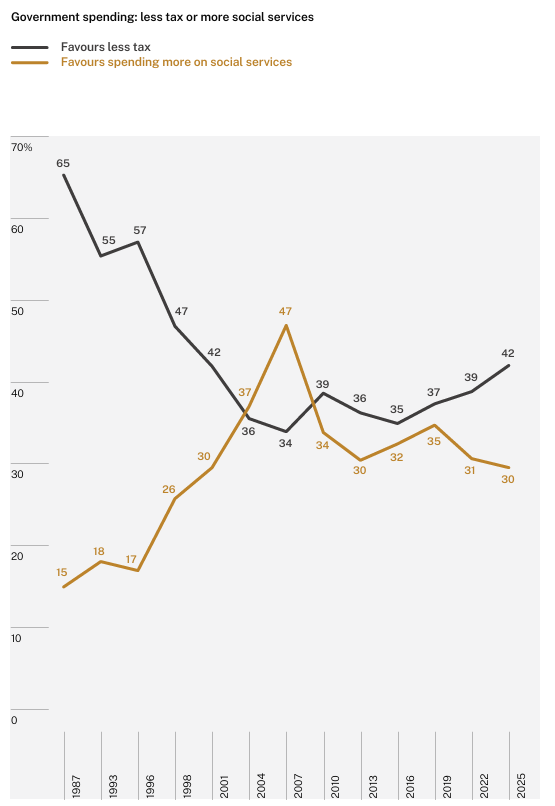
3. Support for lower taxes keeps building
Support for ‘less tax’ rises to 42%, its highest point since the early 1990s, while support for ‘more social services’ drops again, this time to 30%.
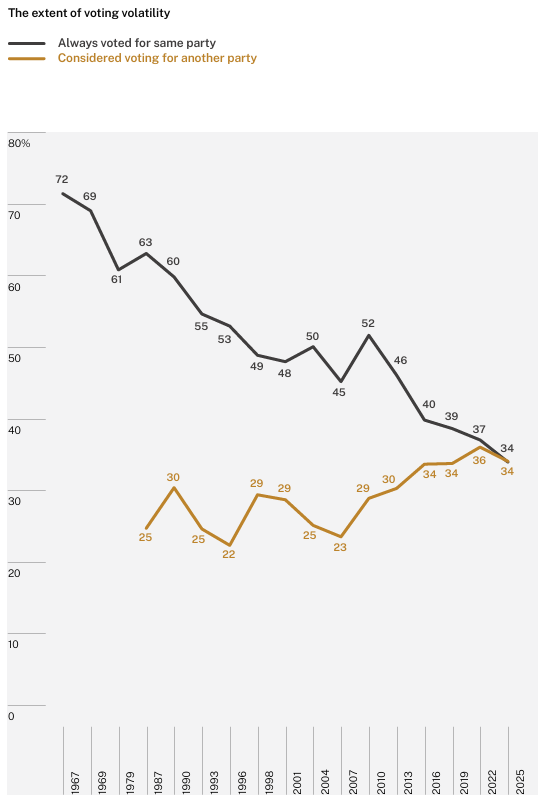
4. Voter volatility has become structural, not cyclical
The AES confirms long-term dealignment:
- the share who ‘always vote for the same party’ has fallen from 72% (1967) to 34% (2025)
- the share who ‘considered voting for another party’ continues to rise.
Volatility is no longer episodic; it is a structural feature of Australian politics. Candidate quality, local issues and short-term economic conditions now exert greater influence than ever before.
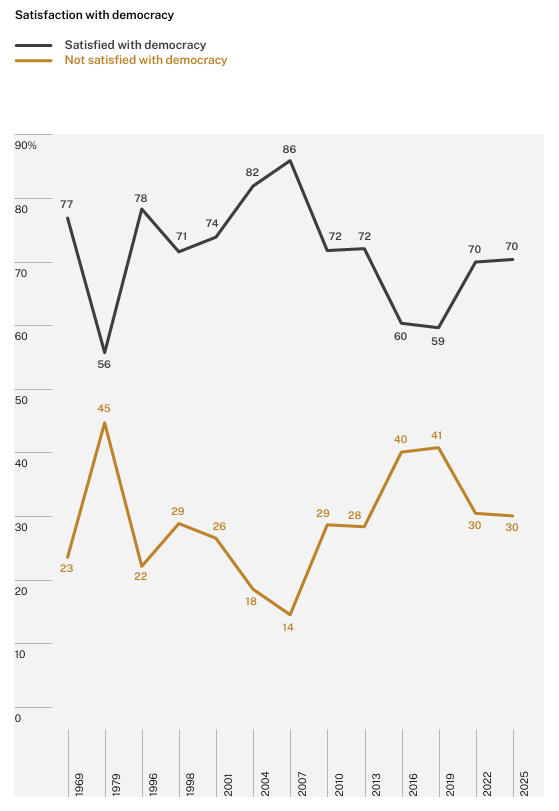
5. Satisfaction with democracy has stabilised, but at low levels
After collapsing in 2019 and 2022, democratic satisfaction has stabilised with:
- ~70% satisfied
- ~30% not satisfied.
This trend suggests a more resigned, less hopeful electorate that is sceptical rather than hostile.
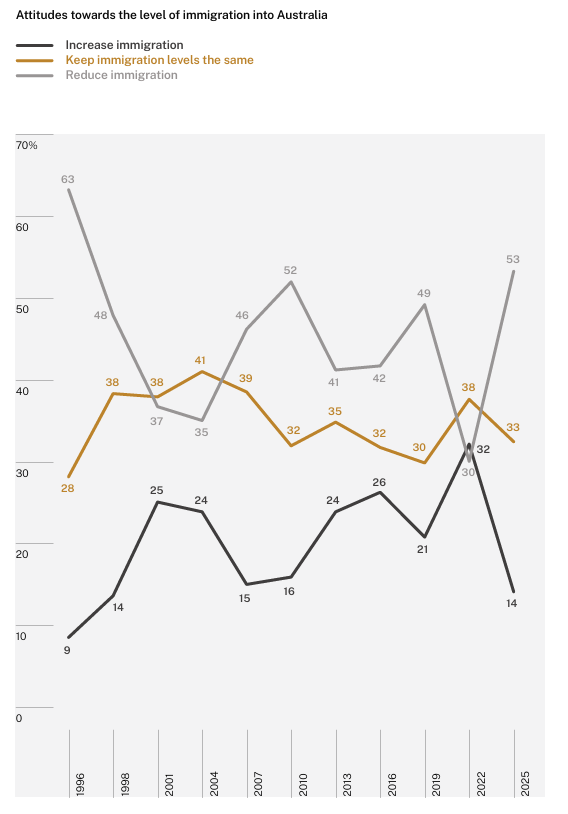
6. Immigration attitudes shift sharply in one of the largest movements in AES history
Between 2022 and 2025, attitudes move decisively toward reducing immigration:
- reduce immigration: 30% → 53%
- increase immigration: 32% → 14%
- keep immigration the same: 38% → 33%
This 23-point surge toward lower intake is one of the largest single-cycle shifts in the AES series.
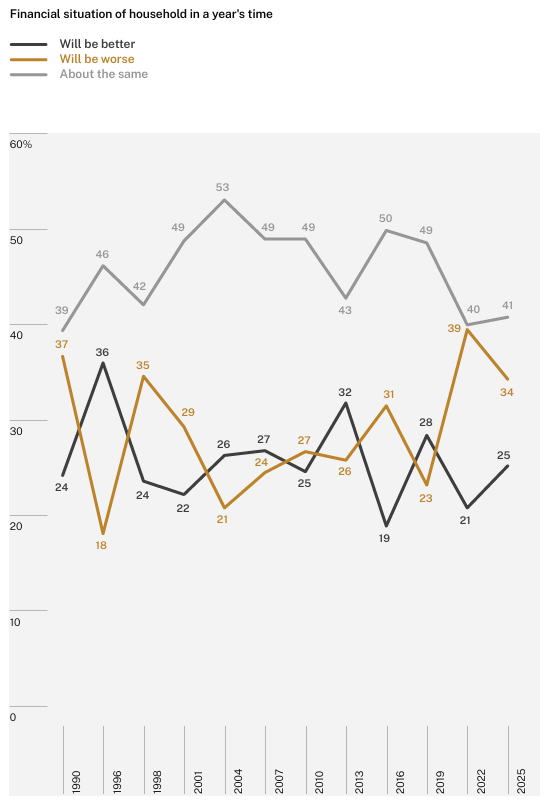
7. Economic pessimism is the strongest in more than three decades
The AES household-financial-expectation series shows:
- 34% expect to be worse off
- 25% expect to be better off
- 41% expect no change.
This remains one of the most pessimistic readings since the early 1990s. It underpins several other shifts: rising support for tax cuts, declining climate urgency, falling optimism about politics, and rising immigration concern.
8. A widening gender divide is reshaping electoral behaviour
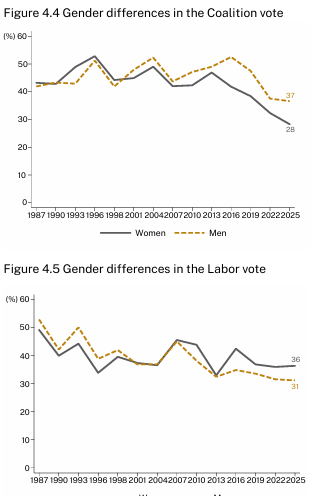
AES gender-breakdown charts show increasingly divergent political behaviour:
- Coalition vote: 37% of men vs 28% of women
- Labor vote: 36% of women vs 31% of men.
Women now consistently lean towards Labor and the Greens, while men lean more toward the Coalition and right-leaning minor parties.
9. Younger generations overwhelmingly reject the Coalition – a deepening generational realignment
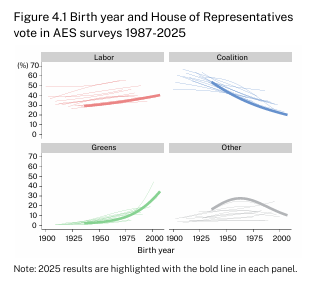
AES generation data confirm a deep cohort divide in Australian politics.
Coalition support falls below 25% among voters born after the mid-1990s, while Greens support reaches very high levels in the youngest adult cohorts. Labor consistently performs better than the Coalition among younger generations, though the Greens remain a significant challenge.
This pattern has been stable across multiple survey waves and represents a persistent cohort effect rather than a short-term cycle. If these generational preferences endure as cohorts age, they pose a long-term structural challenge for the Coalition
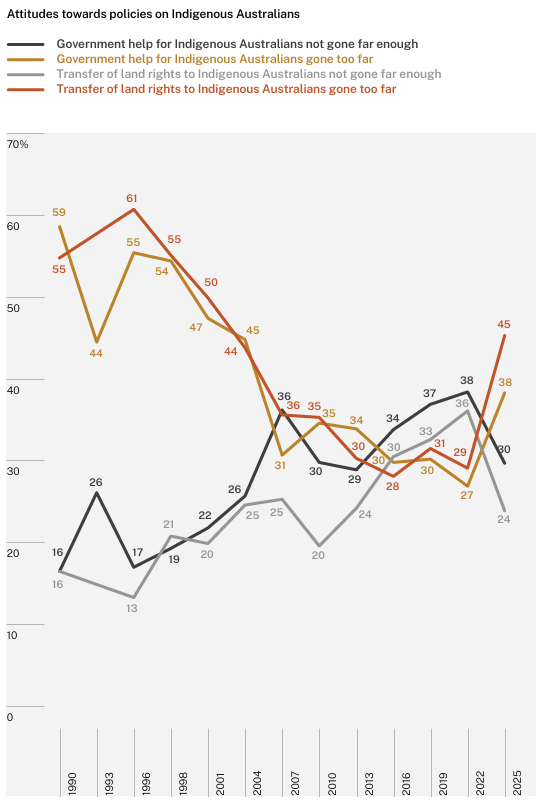
10. Sharp shift in views on Indigenous policy, especially on land rights
The AES reveals a strong post-Voice referendum movement toward the view that Indigenous policies have gone ‘too far.’
Government help for Indigenous Australians:
- not gone far enough: 38% → 30%
- gone too far: 27% → 38%.
Transfer of land rights:
- not gone far enough: 36% → 24%
- gone too far: 29% → 45%.
These shifts represent a decisive turn away from earlier decades of convergence and towards more critical views of government action on Indigenous issues. It is one of the strongest non-economic attitude movements in the 2025 AES.