



The Inside Word
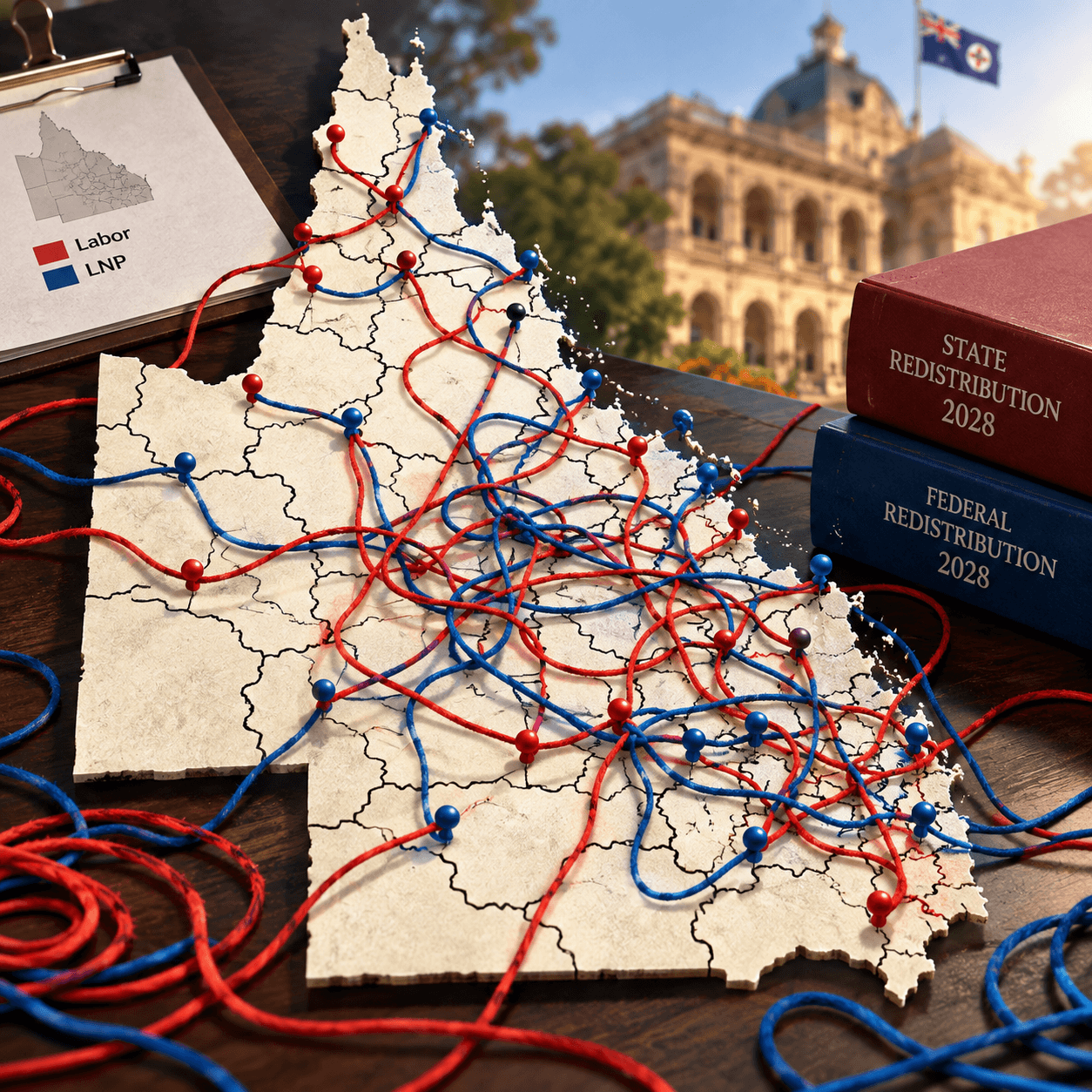
Untangling Queensland’s electoral boundaries
There’s a common saying that goes something like this: there are only three ways to leave parliament. In a box (death), at the ballot box (death by getting voted out) and through the ballot box (death by redistribution).
It’s not an exact science, but ask any MP how seriously they take all three.
If you’ve been confused about which Queensland electoral boundaries are changing, when, and for which parliament, you’re not alone. Two separate redistribution processes are running on overlapping timelines, both landing before 2028, and commentary keeps blurring them together. Here’s the state of play.
The state redistribution is done. The Queensland Redistribution Commission has finalised new boundaries for all 93 Legislative Assembly seats, effective at the 2028 state election. The final boundaries were handed down on 29 June 2026 following the release of the draft boundaries in March.
This was a routine redistribution, triggered by population imbalances rather than any change in seat numbers. The final boundaries were milder than the March draft but still produced real casualties: the KAP seat of Hill and the Labor seat of Toohey were effectively abolished, replaced by a new Labor-leaning Greenbank and LNP-leaning Caboolture. In Logan, a proposed new seat of Marsden was scrapped, with Waterford retained in a more southern form and Woodridge picking up the balance.
The net effect is a two-seat gain for the LNP, a one-seat loss for Labor and a one-seat loss for the KAP, with the LNP’s margin of comfort widening slightly – now roughly a 2.8% uniform swing to threaten government, up from 1.9% under the old boundaries.
The standout casualty is Gaven: frontbencher Meaghan Scanlon holds it on a sub-1% margin, and almost 40% of her electorate was replaced with LNP-leaning territory. Despite real speculation she might switch seats, Scanlon has since confirmed she’ll stay and fight for Gaven in 2028.
The federal redistribution, meanwhile, is only just underway.
Queensland’s 30 federal seats haven’t been redrawn since 2018, and the statutory seven-year trigger landed in 2025 — but the process was deferred twice, finally pending a determination on whether Queensland’s growth would earn it a 31st seat. That determination landed in July 2026: Queensland stays at 30.
The redistribution formally commenced on 28 July, and the first round of public submissions opened on 16 September and closes on 16 October. No federal boundaries have been redrawn yet.
But the seats to watch are already clear from the 2025 result and the growth data behind the entitlement decision.
The outer-Brisbane and Moreton Bay corridor is the one to watch: Petrie, Bonner and Forde all fell to Labor in 2025 on swings between 5.6% and 8.4%, ending a decade of LNP incumbency, and now sit on margins in the mid-single digits — exactly the growth seats most likely to be reshaped.
Dickson remains the most symbolically loaded seat in the state, given Peter Dutton’s 7.7% swing loss to Ali France, and any redraw there will be watched closely.
Longman and Blair sit close to the margin on both sides. Longman is now on a knife-edge margin of just 0.1% after the 2025 result, in a corridor of strong population growth that the redistribution is designed to address. Blair, held by Shayne Neumann on a mid-single-digit margin around Ipswich, has been flagged as competitive in both directions, with One Nation likely to play a role.
Leichhardt is Labor-held for the first time in over a decade, following Warren Entsch’s retirement — a result driven more by personal vote than boundaries, leaving the new member’s margin untested against any redraw.
The general pattern is clear: strong Southeast Queensland growth, which nearly pushed the state to a 31st seat, points towards the redistribution shaving population off the fastest-growing outer-metro seats and pushing enrolment into slower-growing divisions. Indeed, 20 of Queensland’s 30 existing federal electorates currently fall outside at least one of the numerical requirements that will govern the new boundaries. Australian Electoral Commission
Where that redrawn population leans politically will matter enormously.
The state redistribution has already reshaped the 2028 battlefield modestly in the LNP’s favour, with Gaven the standout casualty for Labor.
The federal round is a longer game. But the seats to watch are already identifiable: the outer-Brisbane and Moreton Bay corridor that changed hands in 2025 and sits in some of the state’s fastest-growing areas.
Whoever holds those seats when the new boundaries land will be negotiating both a political mood and a demographic tide. With One Nation’s role adding another layer of uncertainty, both rounds together promise a genuinely volatile couple of years.
Where the ballot box lands will make all the difference in 2028.