



The Inside Word
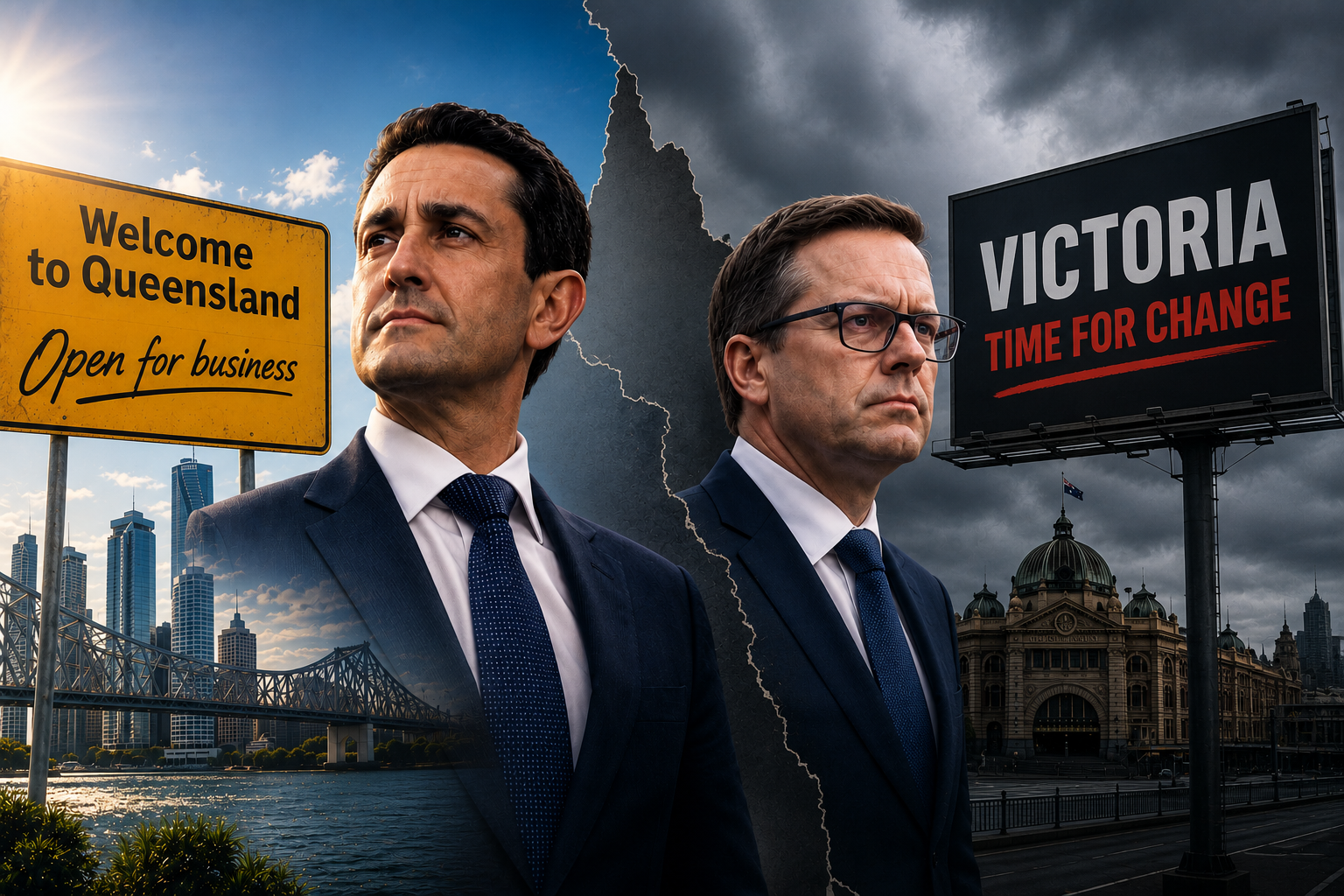
A tale of two states
“It was the best of times, it was the worst of times.”
Charles Dickens was writing about revolution. He could just as easily have been writing about Australian state politics in July.
While Queensland and Victoria occupy opposite ends of the eastern seaboard, this month they occupied opposite ends of the political cycle.
In Queensland, David Crisafulli’s government learnt that winning office is one thing. Owning government is another.
In Victoria, Labor reached a different conclusion altogether. After almost 12 years in office, the party discovered that changing premiers is easier than changing perception.
The Crisafulli Government is no longer new. It has delivered its second budget, survived another round of Budget Estimates, and accumulated enough decisions to be judged on its own record rather than its predecessors. The theatre of opposition is firmly in the rear-view mirror. The keys to the state are now firmly in its hands. And it says Queensland is open for business.
That was the pitch. Stability, fiscal restraint, a fresh start delivered on schedule. What the lead-up to Estimates actually delivered was a rude awakening – reports of reductions to domestic and family violence prevention funding, buried in papers most Queenslanders will never read but every advocacy group in the sector absolutely did – and so did the ALP opposition, which wasted no time in responding.
A Budget and Estimates are not the same exercise. A Budget is where you sell a vision. Estimates is where you defend your decisions – line by line, in front of people whose job it is to find the gap between the press release and the ledger. It’s a dry kind of political theatre, but it runs on numbers, not adjectives.
The domestic and family violence funding line became the week’s defining stoush. Budget papers showed a real reduction in prevention funding. But what’s most surprising is that a government that operated in lockstep all through Opposition, in a political campaign that won it government for the first time in over a decade, left the Minister for the Prevention of Domestic and Family Violence, Amanda Camm, to defend it alone. Asked directly about the cuts, she carried the politics of the issue independently and dismissed the criticism as a “scare campaign”.
This is the less comfortable place every government eventually arrives at: where every decision belongs to it, and there’s no one left to blame for it.
Almost 2,000km south, the problem was altogether different in Melbourne. While Queensland spent July defending decisions, Victoria spent July defending its own existence.
When Jacinta Allan stood aside and Ben Carroll was sworn in as premier, it was less a change of government than an admission that the existing script had run its course. The new premier didn’t sugarcoat why: he’d told Allan plainly she no longer had the numbers in caucus, and she read the room rather than risk the fight. The new premier immediately promised a different relationship with business, a renewed focus on community safety, and a royal commission into corruption in the construction sector.
In other words: Victorian Labor was promising to fix Victorian Labor.
That is the burden of long-term government. Every fresh promise becomes a quiet admission that something should already have been fixed.
The Big Build once symbolised Labor’s ambition. Today it carries a very different kind of weight: cost overruns, ballooning debt, integrity questions, and corruption allegations reaching into the construction sector itself.
Whether entirely fair or not, these four things have merged in the public mind into one impression: a government that got very good at building things, and much worse at keeping the public’s trust while it did.
Politics is often less about reality than accumulated perception. Queensland is discovering that slogans eventually become benchmarks. “Open for business” no longer invites applause. It invites scrutiny, especially when train doors close, leaving many South-East Queenslanders to grapple with reduced timetables, three-car services and school-holiday track closures, all while enterprise bargaining with rail unions dragged on in the background. Ironic, given both sides of politics are still fighting over who deserves credit for 50 cent fares, when the fare is more or less moot if there are no trains coming.
Neither state spent the month arguing over ideology. Neither spent it debating some grand vision for Australia’s future. Instead, both were dragged back to politics in its simplest, least-forgiving form: competence, accountability, trust.
Queensland has entered the stage where every promise now has a price tag attached. Victoria has entered the stage where every explanation sounds like an excuse, no matter who’s giving it.
Perhaps that’s the real tale of these two states. One government is trying to prove it deserves more time. The other is trying to convince voters it hasn’t already had too much.
Dickens famously wrote that every age contains both “the spring of hope” and “the winter of despair.” July suggested Queensland and Victoria are simply experiencing different seasons – and neither premier gets to choose which one they’re standing in.